Showing posts with label inspiration. Show all posts

Wednesday, 20 January 2016

Being Mortal - Atul Gawande book review

"Our reluctancy to honestly examine the experience of ageing and dying has increased the harm we inflict on people and denied them the basic comforts they most need" Atul Gawande 

This is a post that I have been wanting to write for some time. However, due to the very nature of this book's topics it has been one that has taken me a significant amount of time to get through. By no means is this book boring, it is the complete opposite and dare I say it is to date my favourite book that I have read associated with medicine. It is a remarkable book that tackles the subject of mortality, one that many fear, and addresses ideas of ageing, dying and medicine's role in all this. 

"The simple view is that medicine exists to fight death and disease, and that is, of course, it's most basic task" 

Throughout the book Gawande has changed many of my views on medicine, before reading this book I was certain that the role of medicine is to prolong life. However, through Gawande's telling of many different patients who faced terminal cancers of many kinds has persuaded me quite easily that the role of medicine ought to be to enable people to live the best quality of life possible. In many cases this seems counterintuitive when sometimes the best quality of life is in fact not continuing chemotherapy or treatment. Gawande explains the importance of conversation, how regardless of how hard the conversation may be to talk about death, what people want in their last days, what their priorites are, is in fact extremely beneficial, and also proves how important communication is as a doctor. 

However what intrigued me the most in this book was the beginning section on nursing homes. I knew that they were possibly not the best place in the world, having visited one for a relative and also volunteering in a hospice. However, I did not understand their sheer horror for many of the elderly who stay at some, in the sense they are often denied the right to do what they really want. I loved reading of the pioneers who are attempting to change the stereotype of a nursing home and the weird and wonderful experiments they conducted as a result (a personal favourite being when Bill Thomas, a medical director of a nursing home, proposed the idea of introducing 2 dogs, 4 cats and 100 birds as pets into the home, with extradorinaiy results). 

“A few conclusions become clear when we understand this: that our most cruel failure in how we treat the sick and the aged is the failure to recognize that they have priorities beyond merely being safe and living longer; that the chance to shape one’s story is essential to sustaining meaning in life; that we have the opportunity to refashion our institutions, our culture, and our conversations in ways that transform the possibilities for the last chapters of everyone’s lives.” 

However, the book overall has given me a new perspective on mortality, yes it is a scary thought, dying is something I fear greatly, but the idea that with the help of medicine one can try and die peacefully is reassuring. I am young, I haven't even started university, but this book to me is of great relevance, it has not only changed my perspective of the role of medicine, but it has also changed my perspective on life. Whether Gawande's aim of the book was this or not he has shown me to live for quality of life not quantity. 
I end that this book is insightful and moved me significantly, it is important and everyone should read it, to change their ideas on ageing and mortality. 

"In the end, people don't view their life as merely the average of all its moments—which, after all, is mostly nothing much plus some sleep. For human beings, life is meaningful because it is a story."

*quotes all taken from Being Mortal by Atul Gawande* 

Friday, 16 October 2015

Soon we'll cure diseases with a cell, not a pill - TED talk

"We've thought about illness and treatment in terms of a profoundly simple model. In fact, the model is so simple that you could summarize it in six words: have disease, take pill, kill something." - Siddhartha Mukherjee. 

TED talks are notoriously thought provoking, and I always find that after watching one my perception on the world is radically altered. However, this talk in particular by Siddhartha Mukerjee named 'Soon we'll cure diseases with a cell, not a pill' really infulenced and inspired me, to the point that I even caught myself thinking about it whilst I should have been integrating a trigonometric function in my maths lesson. With my understanding of the looming issue of antibiotic resistance growing, due to my EPQ on phage therapy, which is also providing an alternative to antibiotics, I have found myself intruiged at learning about alternatives to antiobiotics, and this TED talk covered the topic in a refreshing way. Instead of focusing on the problem of antibiotic resistance, Mukherjee focuses on the use of stem cells to create a new model of treatment and a new view on thinking about illness. Suggesting an alternative to the lock and key model, Mukherjee introudces the idea that we as a society need to revaluate our ideas on medicine; medicine no longer needs to be a pill. Today we can utilise our environment, holistic approaches, cells, and of course the classic 'pills' as forms of treatment. 
Mukherjee suggests the new model of cell, organ, environment to treat a disease and goes into great depth in his talk about how this model was devised. 

I truely believe that in order to avoid a huge health catastrophe we need to find an alternative to anitiobiotics. We should not eradicate them completely, as they are indeniable extremely useful drugs. However, due to antibiotic resistance, we must consider other treatment options and Mukherjee's use of stem cells and a new model for medicine just may be an answer. 
I highly recommend watching this TED talk, the link is below: 
Link to TED talk - soon we'll cure diseases with a cell, not a pill by Siddhartha Mukherjee

Sunday, 20 September 2015

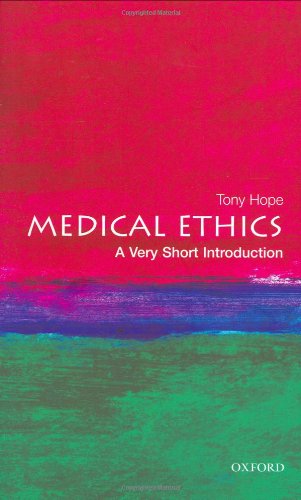
Medical Ethics A Very Short Introduction - Book Review

One of the things that has come to my attention recently is that my own knowledge of ethical concepts and particularly medical ethics was extremely limited. Therefore in the hope to educate myself on this topic I bought a book named: Medical Ethics A Very Short Introduction by Tony Hope. The book itself was ideal for introducing anyone to the basics of medical ethics, explaining extremely well the different terminology within this subject and also introducing different ideas and points of view, there was also a chapter on how to construct an ethical argument, which was particularly useful.

Within the book itself there were different chapters that each focused specifically on one ethical dilemma, these included:

  • euthanasia
  • the value of life - funding within medicine and how to allocate funding 
  • pre-birth ethics - including the idea of should anyone be allowed IVF 
  • genetics - how modern genetics is testing confidentiality 
  • medical research 
  • mental illness and the inconsistencies with the mentally ill
  • everyday ethical dilemmas
A Brief synopsis of ethical terms:
From this book I learnt particularly about different ethical terms and views, below I will attempt to define what these mean, from what I have learnt from this book, and what I have learnt from further research on basic ethical terms. 
  • Absolutism - those who believe in this will have the view that there is only one correct approach to the moral life, regardless of persons and cultures
  • Altruism - regard for others, the opposite of egoism 
  • Autonomy - the capacity to think, decide, and act on the basis of such though and decision, freely and independently. The idea that one should respect the individuals self-determination
  • Beneficence - the moral importance of doing good to others, one should help others and increase the good of others when one is knowingly in the position to do so
  • Confidentiality - one should keep one's promises about information, a subset of fidelity
  • Deontological (non-consequentialist) theories - the idea that the values of actions lie in the motives not the consequences
  • Duty - an action due by moral or legal obligation 
  • Fidelity - principle that one should keep one's promises
  • Justice - the idea of fairness, one gives what is owed and therefore deserved
  • Morality - the science of human duty
  • Non-maleficience - the principle that one should avoid harming others
  • Paternalism - the idea that a person's liberty can justifiably be restricted in order to prevent self-had or to promote the person's well-being
  • Utilitarianism - the view that an act is right if it leads to the maximisation of good consequences for the most people
  • Veracity - the principle that one should tell the truth 
The book itself was extremely short, being less than 150 pages, but as a consequence it was extremely concise and effective in informing me on the basics of medical ethics. It opened my eyes to ethical situations that I had not considered, such as whether we have the right to detain a mentally ill patient against their will. It also provided me with a new perspective on many views, such as the value of human life, if everyone should be allowed IVF and the restrictions we put on medical research.

However, out of everything this book was extremely useful in presenting everyday situations the doctors encounter related to ethics, which is helpful in informing me of future complications I could potentially face when I am a doctor myself. 

Friday, 4 September 2015

The end of summer update

Sadly the summer holidays are coming to a close, and I apologise for my lack of posts on this blog. I did have the full intention of posting at the very least weekly, my aim was evidently more. However, through going abroad with my family, and the stress of receiving AS level results, along with university trips and the UKCAT, I am sorry to say I did forget about this blog for a while. I also spent much of my summer holiday recharging, because the next few months I know will be extremely hectic and extremely important. 
I start sixth form again on Monday and that will mark the start of a transition back into normality, but also should result in structure and free time, as I will only be studying maths, biology and chemistry as opposed to maths, further maths, french, biology and chemistry, which is what I did last year. This newfound free time will allow me to focus on reading around the subject of medicine, broadening my knowledge on topical issues and proceed with an EPQ on phage therapy. No doubt this will result in a multitude of future posts that you can look forward too. 


Friday, 31 July 2015

The Selfish Gene - book review

The Selfish Gene is hailed as a scientific masterpiece and whilst it is not directly linked to medicine it is of huge importance and for me significance for anyone who wants to venture into medicine. Medicine is the joining of the study of science with the social impact of working with patients, so therefore to not read this book purely for the fact it is not specifically medical would be wrong. The book deals with evolution, the way in which genes utilise us the survival machines to survive and live an immortal life as possible. Dawkins creates a book that explains seemingly complex scientific concepts without the use of any real scientific language and no mathematics; he explains ideas of genetics without the language of a geneticist, hence making the whole book extremely accessible and enjoyable to read for anyone. Therefore I agree with W.D Hamilton who states that ‘this book should be read, can be read, by almost anyone’.

For me the book has given me a new outlook on life. Not the pessimistic outlook and existential crisis that it has given so many, but in fact an eye opening outlook. To view evolution as a product of genes wanting to survive and not organisms is refreshing and an idea that is completely new to me, as throughout school whilst learning about evolution in biology lessons I have always been told that natural selection favours characteristics that allow survival of the organism, the idea that it is in fact the genes that are attempting to survive and are controlling us to an extent is never mentioned.  I found the first few chapters to be the most interesting, in particular the second chapter ‘the replicators’ as I have always been haunted with the question of how did chemicals evolve to become complex organisms that roam Earth today. I was fascinated to learn of replicator chemicals that lived in the primeval soup and how over time they created survival machines in order to populate the soup further, and these survival machines eventually evolved to become the modern day organisms. If anything the whole book has answered many of my questions regarding evolution and the mechanisms behind it. However, similarly the book has answered questions that I did not realise I had such as how can predators and prey co-exist? How altruism evolved? Why we have so many or so few children? The list is endless, and all the while the book introduces new ideas to me from explanation of memes (‘the seemingly self-replicating pool of art and science, literature and music, knowledge, folklore and platitude that survives with each human life’) to why we protect our family members more often than strangers.

Monday, 22 June 2015

Volunteer Diary 4 and 5 - a recap

To say that I have been busy is an understatement. I had the assumption that after my exams had finished I would be graced with time to focus on this blog, to work on my university application and to get ahead in A2 work, along with socialising with my friends and also complete some more work experience. Well it turns out that in doing all of this I have lost track of time and I have only just realised how much I have neglected this blog, and for that I apologise.

So since my last post I have continued with my MOOC on the clinical psychology of children and young adults, and I have learnt so much about the formation of mental illnesses and how complex they are. I also feel as if through this MOOC I have significantly improved my own independent learning skills.

However, my voluntary work is what is continuing to inspire me. Each week I am continuing to strengthen the bonds and friendships I am making with the children, whilst learning more and more about their personal disabilities and challenges, along with getting to know their parents. On Friday we had a special skills ice skating lesson, and as well as improving my own skating ability, I learnt that I have hugely impacted on particular boys life. The boy is one who I looked after on my first week of volunteering and he suffers from dyspraxia. Despite not being paired with him that week, he still insisted on being paired with me, and even left the volunteer who was initially paired with him to skate with me, continuously hugging me and telling me that I am his favourite. Whilst this may just be a phase, I can help but feel almost a sense of accomplishment, if not at least a huge humbling feeling that I have influenced this boy's life so much, that he wants to work with me every week (last week when I was paired with him he danced around the seating area in the ice rink with excitement and shouting "YES I GET TO WORK WITH ELLIE") To see a child respond in that way is extremely inspiring, to know that you alone can improve their mood that significantly proves to me alone why I do this voluntary work. Of course it is not just this boy who inspires me, they all do. Even when we were completing the skills lesson, all of the children joined in, despite many uncomfortable glances at first, they all want to try new things, and they are all willing to do new things.

I feel that through my voluntary work I can see myself growing as a person. Not only do the children that I work with inspire me each week, but so do the incredible other volunteers who I have been able to meet along the way. Before I started this voluntary work I had a tendency to be quite shy around new people. Whether shy is the right adjective is debatable, but I was not one to go up to new people at random and create a conversation or friendship, I liked to take a slower approach, but now I have certainly become more outgoing, indefinitely more caring and my communication skills have improved immensely. I have gained a lot from my voluntary work, but maybe more so than anything I am gaining incredible memories,  each week I have the chance to help these children, to improve what may have been an awful week for them, and have a great time at the same time. What more could you want?

Wednesday, 10 June 2015

Volunteer Diary 3 - autism

Most of the children I work with at my voluntary work have mild disabilities, ones that realistically if you did not know where present, you would think were non existent in these children. However, there is one boy who it is quite clear has a much more severe disability, he suffers from severe autism, and this week I was asked to look after him. 

I had never had any experience with autism until today, I had merely read about, so I was excited to  be able to look after this boy and learn more about this devastating disability. From skating with this boy for an hour and a half, it became apparent that I really did not know much about autism, just the basics, but one thing I did notice immediately is that this boy as cliché and basic as it sounds, was in another world of his own. The communication between the two of us was very basic, he would reply yeah to most of my questions, and when he replied no there was often a long pause and no sounded almost aggressive. I also noticed that much of our communication was not through words, but facial expressions, he would skate in front of me and every few minutes would look back and smile to check I was there, he also would pull funny face at me, and if I reciprocated would laugh. 

As well as taking the children ice skating, as volunteers we are responsible for making sure they eat, for most children this is taking them to the cafe and buying chips and chicken nuggets, but this boy came with a backpack full of his food. What was interesting to me was that instead of asking to get off the ice and eat, he would stop at the exit of the rink and just stand there till I asked get off? It was almost as if he was waiting for my permission. 

After the session today I left feeling very reflective, whilst I did feel quite sad that this boy was so oblivious to the world and appeared so confused, I also left feeling satisfied and that I had really made a difference and helped him today, because it was obvious that when he was skating around the ice rink he seemed much calmer and much happier. It made me realise that I no longer do this voluntary work to gain experiences that will help me with a medical degree, but that now I actually do this voluntary work because I genuinely care about the children who come. Over the time I have been volunteering at this charity I have got to know many of the children and they will come up and hug me upon arrival, and even know I am meeting new children every week. For example, this week a boy who I had never looked after before came up to me, shook my hand, told me he was the science genius, and proceeded to explain to me how he would clone a dinosaur, and from the biology lessons I have had on clones I can confirm that what this 9 year old was saying, was in fact true. I suppose what I am trying to say that this voluntary work is something that I love to do, and that each week the children there never cease to amaze me and provide me with new memories, allowing me to finish my week knowing that if all else failed that week, I have improved their day and week, which ultimately is the aim in my opinion. 

Wednesday, 6 May 2015

TED Talks

The internet for me is one of the greatest sources for information and inspiration. Every day I am constantly fascinated and informed by new facts and ideas I find on the internet.
In my opinion the greatest website for daily inspiration and for ideas to change your outlook on the world is TED talks. https://www.ted.com/talks

I will not go into too much detail about the website as honestly it is already extremely well known, but for those who are unfamiliar with the site, it in short consists of different videos on fascinating topics ranging from that of quantum physics to political stories, with a personal favourite being I am the son of a terrorist by Zak Ebrahim. https://www.ted.com/talks/zak_ebrahim_i_am_the_son_of_a_terrorist_here_s_how_i_chose_peace

I will not go into a review of all of my favourite TED talks because unfortunately I haven't the time at the moment, I think it may be a possible summer holiday project?
However, before I leave to continue yet even more revision for AS levels, I will say if you are to watch any TED talks then it they should be the one linked above by Zak Ebrahim, but also the one I shall leave linked below called One more reason to get a good night's sleep by Jeff Iliff. This was the TED talks that originally sparked one of my interests in neurology, and inspired and has left me fascinated into the reason to why we actually sleep.