Showing posts with label medical books. Show all posts

Wednesday, 20 January 2016

Being Mortal - Atul Gawande book review

"Our reluctancy to honestly examine the experience of ageing and dying has increased the harm we inflict on people and denied them the basic comforts they most need" Atul Gawande 

This is a post that I have been wanting to write for some time. However, due to the very nature of this book's topics it has been one that has taken me a significant amount of time to get through. By no means is this book boring, it is the complete opposite and dare I say it is to date my favourite book that I have read associated with medicine. It is a remarkable book that tackles the subject of mortality, one that many fear, and addresses ideas of ageing, dying and medicine's role in all this. 

"The simple view is that medicine exists to fight death and disease, and that is, of course, it's most basic task" 

Throughout the book Gawande has changed many of my views on medicine, before reading this book I was certain that the role of medicine is to prolong life. However, through Gawande's telling of many different patients who faced terminal cancers of many kinds has persuaded me quite easily that the role of medicine ought to be to enable people to live the best quality of life possible. In many cases this seems counterintuitive when sometimes the best quality of life is in fact not continuing chemotherapy or treatment. Gawande explains the importance of conversation, how regardless of how hard the conversation may be to talk about death, what people want in their last days, what their priorites are, is in fact extremely beneficial, and also proves how important communication is as a doctor. 

However what intrigued me the most in this book was the beginning section on nursing homes. I knew that they were possibly not the best place in the world, having visited one for a relative and also volunteering in a hospice. However, I did not understand their sheer horror for many of the elderly who stay at some, in the sense they are often denied the right to do what they really want. I loved reading of the pioneers who are attempting to change the stereotype of a nursing home and the weird and wonderful experiments they conducted as a result (a personal favourite being when Bill Thomas, a medical director of a nursing home, proposed the idea of introducing 2 dogs, 4 cats and 100 birds as pets into the home, with extradorinaiy results). 

“A few conclusions become clear when we understand this: that our most cruel failure in how we treat the sick and the aged is the failure to recognize that they have priorities beyond merely being safe and living longer; that the chance to shape one’s story is essential to sustaining meaning in life; that we have the opportunity to refashion our institutions, our culture, and our conversations in ways that transform the possibilities for the last chapters of everyone’s lives.” 

However, the book overall has given me a new perspective on mortality, yes it is a scary thought, dying is something I fear greatly, but the idea that with the help of medicine one can try and die peacefully is reassuring. I am young, I haven't even started university, but this book to me is of great relevance, it has not only changed my perspective of the role of medicine, but it has also changed my perspective on life. Whether Gawande's aim of the book was this or not he has shown me to live for quality of life not quantity. 
I end that this book is insightful and moved me significantly, it is important and everyone should read it, to change their ideas on ageing and mortality. 

"In the end, people don't view their life as merely the average of all its moments—which, after all, is mostly nothing much plus some sleep. For human beings, life is meaningful because it is a story."

*quotes all taken from Being Mortal by Atul Gawande* 

Sunday, 20 September 2015

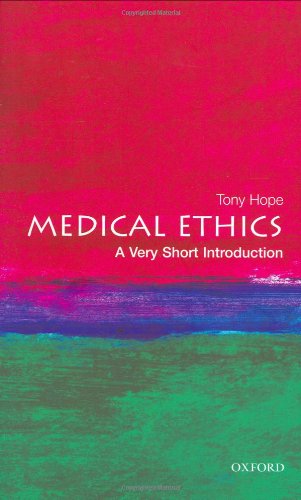
Medical Ethics A Very Short Introduction - Book Review

One of the things that has come to my attention recently is that my own knowledge of ethical concepts and particularly medical ethics was extremely limited. Therefore in the hope to educate myself on this topic I bought a book named: Medical Ethics A Very Short Introduction by Tony Hope. The book itself was ideal for introducing anyone to the basics of medical ethics, explaining extremely well the different terminology within this subject and also introducing different ideas and points of view, there was also a chapter on how to construct an ethical argument, which was particularly useful.

Within the book itself there were different chapters that each focused specifically on one ethical dilemma, these included:

  • euthanasia
  • the value of life - funding within medicine and how to allocate funding 
  • pre-birth ethics - including the idea of should anyone be allowed IVF 
  • genetics - how modern genetics is testing confidentiality 
  • medical research 
  • mental illness and the inconsistencies with the mentally ill
  • everyday ethical dilemmas
A Brief synopsis of ethical terms:
From this book I learnt particularly about different ethical terms and views, below I will attempt to define what these mean, from what I have learnt from this book, and what I have learnt from further research on basic ethical terms. 
  • Absolutism - those who believe in this will have the view that there is only one correct approach to the moral life, regardless of persons and cultures
  • Altruism - regard for others, the opposite of egoism 
  • Autonomy - the capacity to think, decide, and act on the basis of such though and decision, freely and independently. The idea that one should respect the individuals self-determination
  • Beneficence - the moral importance of doing good to others, one should help others and increase the good of others when one is knowingly in the position to do so
  • Confidentiality - one should keep one's promises about information, a subset of fidelity
  • Deontological (non-consequentialist) theories - the idea that the values of actions lie in the motives not the consequences
  • Duty - an action due by moral or legal obligation 
  • Fidelity - principle that one should keep one's promises
  • Justice - the idea of fairness, one gives what is owed and therefore deserved
  • Morality - the science of human duty
  • Non-maleficience - the principle that one should avoid harming others
  • Paternalism - the idea that a person's liberty can justifiably be restricted in order to prevent self-had or to promote the person's well-being
  • Utilitarianism - the view that an act is right if it leads to the maximisation of good consequences for the most people
  • Veracity - the principle that one should tell the truth 
The book itself was extremely short, being less than 150 pages, but as a consequence it was extremely concise and effective in informing me on the basics of medical ethics. It opened my eyes to ethical situations that I had not considered, such as whether we have the right to detain a mentally ill patient against their will. It also provided me with a new perspective on many views, such as the value of human life, if everyone should be allowed IVF and the restrictions we put on medical research.

However, out of everything this book was extremely useful in presenting everyday situations the doctors encounter related to ethics, which is helpful in informing me of future complications I could potentially face when I am a doctor myself. 

Friday, 31 July 2015

The Selfish Gene - book review

The Selfish Gene is hailed as a scientific masterpiece and whilst it is not directly linked to medicine it is of huge importance and for me significance for anyone who wants to venture into medicine. Medicine is the joining of the study of science with the social impact of working with patients, so therefore to not read this book purely for the fact it is not specifically medical would be wrong. The book deals with evolution, the way in which genes utilise us the survival machines to survive and live an immortal life as possible. Dawkins creates a book that explains seemingly complex scientific concepts without the use of any real scientific language and no mathematics; he explains ideas of genetics without the language of a geneticist, hence making the whole book extremely accessible and enjoyable to read for anyone. Therefore I agree with W.D Hamilton who states that ‘this book should be read, can be read, by almost anyone’.

For me the book has given me a new outlook on life. Not the pessimistic outlook and existential crisis that it has given so many, but in fact an eye opening outlook. To view evolution as a product of genes wanting to survive and not organisms is refreshing and an idea that is completely new to me, as throughout school whilst learning about evolution in biology lessons I have always been told that natural selection favours characteristics that allow survival of the organism, the idea that it is in fact the genes that are attempting to survive and are controlling us to an extent is never mentioned.  I found the first few chapters to be the most interesting, in particular the second chapter ‘the replicators’ as I have always been haunted with the question of how did chemicals evolve to become complex organisms that roam Earth today. I was fascinated to learn of replicator chemicals that lived in the primeval soup and how over time they created survival machines in order to populate the soup further, and these survival machines eventually evolved to become the modern day organisms. If anything the whole book has answered many of my questions regarding evolution and the mechanisms behind it. However, similarly the book has answered questions that I did not realise I had such as how can predators and prey co-exist? How altruism evolved? Why we have so many or so few children? The list is endless, and all the while the book introduces new ideas to me from explanation of memes (‘the seemingly self-replicating pool of art and science, literature and music, knowledge, folklore and platitude that survives with each human life’) to why we protect our family members more often than strangers.

Wednesday, 10 June 2015

Finished with exams!

Yesterday was my last exam, and today I have never felt more liberated and free. As a whole I am happy with my exams, I feel as if the majority went extremely well, but I am disappointed with how my mechanics 1 module in further maths went. I suppose that the problem with exams is that in one way it is the luck of the draw, sometimes the wrong questions come up and it just doesn't go as well as you hoped, which for me happened in my M1 exam, and it is infuriating because I know that I am capable of getting 100% sometimes on my M1 papers, but that day it just all went wrong. Apart from that the rest of my exams went well. It is true what they say though AS is much harder than GCSE.

However, now I am just happy to be done, to have time again that is not taken up revising, time that I will now focus on utilising for both actually having a social life, but also to spend more time on working on this blog, working on my MOOC, reading as many medical related novels as possible and begin researching a topic for the EPQ that I hope to complete this forth coming year.